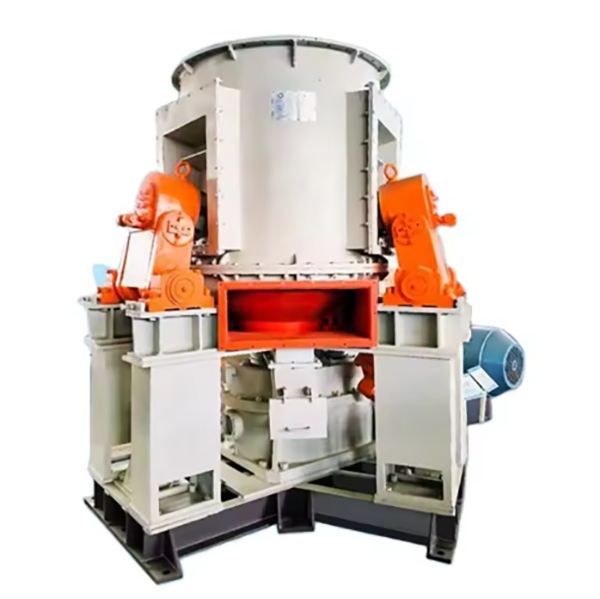
I. Decreased Crushing Efficiency and Unmet Capacity Expectations
Common Causes
l Excessive feed particle size, too many large chunks, or high moisture and viscosity of materials, leading to blockage or poor feeding in the crushing chamber.
l Severe wear and tear of the crushing chamber liners, resulting in deformed cavity shape that fails to achieve effective laminated crushing.
l Excessively adjusted discharge opening, causing insufficient material crushing.
l Abnormal motor speed, or loose and slipping drive belts, leading to insufficient power transmission.
l Wear of the eccentric sleeve and excessive clearance, affecting the swing amplitude and frequency of the crushing cone.
l Deviation in the axis position of the eccentric bushing's taper hole and incorrect eccentricity angle, resulting in the failure of the intersection point of the moving cone's axis to coincide with the center of the spherical bearing, damaging the stable operation of the moving cone and causing "material accumulation" (Ji Liping, 2017, "Fault Analysis of Symons Cone Crushers").
l The crushing chamber type (such as the length of the parallel zone) does not meet production requirements, affecting the efficiency of material crushing and discharge (Ji Liping, 2017, "Fault Analysis of Symons Cone Crushers").
Solutions
l Strictly control the feed particle size to avoid exceeding the rated maximum feed size of the equipment. Pre-dry or screen high-moisture and viscous materials, and regularly clean the accumulated material attached to the inner wall of the crushing chamber.
l Inspect the wear condition of the liners. If the wear amount reaches the limit or the cavity shape is deformed, promptly replace the mantle and concave liners to ensure the integrity of the crushing chamber structure.
l Reasonably adjust the discharge opening size according to production needs, calibrate the adjusting screw and locking device with reference to the equipment parameter manual, and ensure the accuracy of the discharge opening.
l Detect the operating speed of the motor, check if the power supply voltage is stable, fasten the drive belt or replace the aging belt, and adjust the belt tension to an appropriate range.
l Disassemble and inspect the fit clearance between the eccentric sleeve and the copper bushing. If the clearance exceeds the specified value (usually ≥0.5mm), replace the eccentric sleeve or copper bushing, reassemble and calibrate the eccentricity.
l If the axis deviation of the eccentric bushing is small, adjust the relative position by adding or removing gaskets between the bowl-shaped bushing and the bowl-shaped bushing support to make the intersection point of the moving cone's axis coincide with the spherical center. If the deviation or eccentricity angle is too large, directly replace the qualified eccentric bushing (Ji Liping, 2017, "Fault Analysis of Symons Cone Crushers").
l Investigate the root cause of the cavity type problem. If it is a defect of the concave or mantle components, replace the corresponding components to correct key structural parameters such as the length of the parallel zone (Ji Liping, 2017, "Fault Analysis of Symons Cone Crushers").
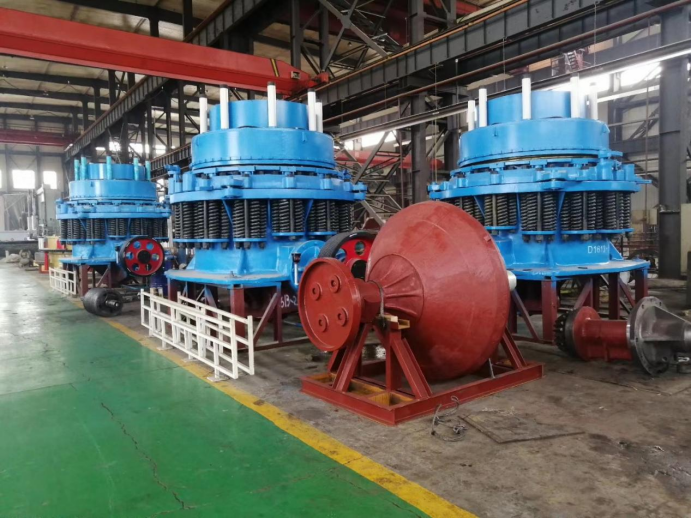
II. Uneven Finished Product Particle Size and High Needle-Flake Content
Common Causes
l Improper selection of crushing chamber type, failing to match the appropriate cavity type (such as standard cavity, short-head cavity) according to material characteristics.
l Installation deviation of the liners, uneven clearance between the mantle and concave liners, leading to insufficient local crushing force.
l Unreasonable adjustment of the eccentric stroke, too small stroke to achieve sufficient laminated crushing.
l Unstable material feed rate, resulting in "underfeeding" or "blockage" in the crushing chamber and affecting the crushing effect.
l Excessively large and hard material particles, causing particle segregation in the crushing chamber and preventing some materials from being fully crushed (Sichuan Leimeng Machinery Equipment Co., Ltd., 2025, "What to Do If the Cone Crusher Has Uneven Discharge, Poor Particle Shape, and Greatly Reduced Production Efficiency? 5 Causes and 3 Solutions!"; Zhengzhou Xinguang Mining Machinery Manufacturing Co., Ltd., 2025, "Crusher Manufacturer: What Are the Causes of Uneven Discharge of Cone Crushers? How to Solve Them?").
l Excessively high material moisture content, causing mutual adhesion and blocking the crushing chamber, reducing crushing capacity (Sichuan Leimeng Machinery Equipment Co., Ltd., 2025, "What to Do If the Cone Crusher Has Uneven Discharge, Poor Particle Shape, and Greatly Reduced Production Efficiency? 5 Causes and 3 Solutions!"; Zhengzhou Xinguang Mining Machinery Manufacturing Co., Ltd., 2025, "Crusher Manufacturer: What Are the Causes of Uneven Discharge of Cone Crushers? How to Solve Them?").
l Deviated feeding position, resulting in uneven material distribution within 360° of the crushing chamber and unbalanced unilateral force on the moving cone (Zhengzhou Xinguang Mining Machinery Manufacturing Co., Ltd., 2025, "Crusher Manufacturer: What Are the Causes of Uneven Discharge of Cone Crushers? How to Solve Them?").
l Too low on-site working voltage, insufficient motor power, and insufficient crushing force (Sichuan Leimeng Machinery Equipment Co., Ltd., 2025, "What to Do If the Cone Crusher Has Uneven Discharge, Poor Particle Shape, and Greatly Reduced Production Efficiency? 5 Causes and 3 Solutions!"; Zhengzhou Xinguang Mining Machinery Manufacturing Co., Ltd., 2025, "Crusher Manufacturer: What Are the Causes of Uneven Discharge of Cone Crushers? How to Solve Them?").
Solutions
l Replace the liners of the corresponding cavity type according to material hardness and crushing needs (such as short-head cavity for fine crushing and standard cavity for medium crushing).
l Disassemble and reinstall the liners, use feeler gauges to detect the clearance between the mantle and concave liners at various parts to ensure uniformity, fasten the fixing bolts of the liners and perform anti-loosening treatment.
l Adjust the eccentric stroke according to the equipment operation manual, optimize parameters in combination with capacity and particle shape requirements. Usually, a medium stroke is selected for medium crushing conditions and a larger stroke for fine crushing.
l Inspect the operation status of the feeder, adjust the feeding speed to ensure uniform and continuous feeding, and avoid feed interruption or excessive accumulation.
l Preprocess oversized materials, pre-crush large chunks of materials in advance, and match more suitable crushing processes for high-hardness materials to ensure the materials meet the equipment processing standards (Sichuan Leimeng Machinery Equipment Co., Ltd., 2025, "What to Do If the Cone Crusher Has Uneven Discharge, Poor Particle Shape, and Greatly Reduced Production Efficiency? 5 Causes and 3 Solutions!").
l Dry high-moisture materials to reduce material adhesion, and regularly clean the accumulated material in the crushing chamber (Sichuan Leimeng Machinery Equipment Co., Ltd., 2025, "What to Do If the Cone Crusher Has Uneven Discharge, Poor Particle Shape, and Greatly Reduced Production Efficiency? 5 Causes and 3 Solutions!").
l Modify the feeding hopper to allow materials to be evenly discharged to the distribution plate, ensuring balanced feeding in all areas of the crushing chamber (Sichuan Leimeng Machinery Equipment Co., Ltd., 2025, "What to Do If the Cone Crusher Has Uneven Discharge, Poor Particle Shape, and Greatly Reduced Production Efficiency? 5 Causes and 3 Solutions!").
l Detect the on-site voltage to ensure it meets the equipment operation requirements. If necessary, configure a voltage stabilizer, and check the belt tension to avoid power transmission loss (Sichuan Leimeng Machinery Equipment Co., Ltd., 2025, "What to Do If the Cone Crusher Has Uneven Discharge, Poor Particle Shape, and Greatly Reduced Production Efficiency? 5 Causes and 3 Solutions!").